| Genus | Ficus |
|---|---|
| Species | rumphii |
| Common Name | rumphii |
| Description | Download the RNA-Seq raw fastq sequences Download the RNA-Seq assembled sequences and annotation Related analysis: Ficus rumphii is a banyan fig species in the family Moraceae. No subspecies are listed in the Catalogue of Life. The species can be found in: India, southern China, Indo-China and Malesia. Arbor, about 15 meters high, usually epiphytic, with gray bark and wrinkles on the trunk when dry. The leaves are leathery, heart-shaped to ovate-heart-shaped, 6-13 cm long and 6-11 cm wide at the widest point, tapering at the tip, shallowly heart-shaped to broadly wedge-shaped at the base, hairless on both sides, with five primary veins originating from the base, the outer two veins short and thin, with 5-6 pairs of lateral veins; leaf stalks are 6-8 cm long, hairless; stipules are lanceolate-ovate, 1.2-2.5 cm long, leaving distinct stipule scars after falling off. The plant is dioecious, with figs lacking a common stalk, paired or clustered in the leaf axils of the fallen hazel branches, spherical, 10-15 mm in diameter, initially with black spots, turning purple-black when ripe, with slightly umbilicate apical bracts, and three basal bracts, small and round; very few male flowers, scattered on the inner wall of the figs, with 3 spoon-shaped petals, and a single stamen; gall and neuter flowers have lanceolate petals; male flower petals are similar to gall flowers, ovary is oval and smooth. The thin fruit is covered with warts and mucilage, with a long style and a club-shaped stigma. |
| Organism Image | 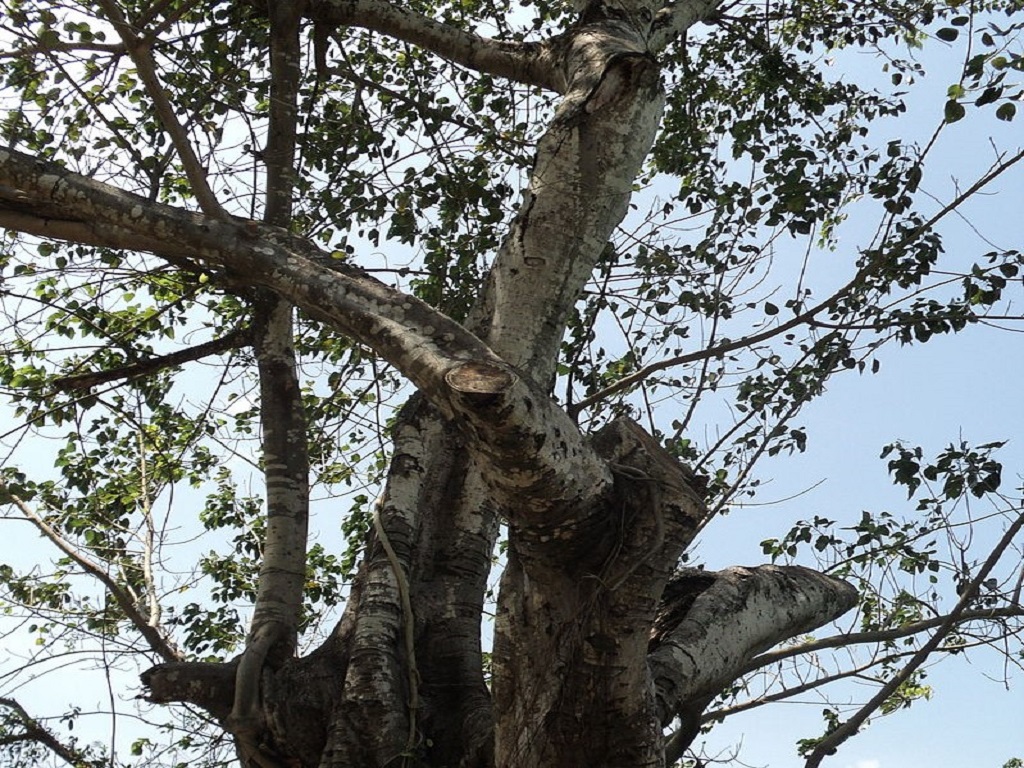 |
Ficus rumphii
Summary