| Genus | Ficus |
|---|---|
| Species | variegata |
| Common Name | variegata |
| Description | Download the RNA-Seq raw fastq sequences Download the RNA-Seq assembled sequences and annotation Related analysis: Ficus variegata is a well distributed species of tropical fig tree. It occurs in many parts of Asia, islands of the Pacific and as far south east as Australia. There is a large variety of local common names including common red stem fig, green fruited fig and variegated fig. A non strangling fig which may reach 30 metres in height. The tree is evergreen when young but becomes briefly deciduous as it grows older. In Australia the fruit are eaten by cassowaries and double-eyed fig parrots. Ficus variegata is dioecious, with male and female flowers produced on separate individuals. Bark gray to grayish brown, smooth. Branchlets green, sparsely pubescent. Stipules ovate-lanceolate, 1-1.5 cm, glabrous. Leaves alternate; petiole 2.5-6.8 cm; leaf blade broadly ovate to ovate-elliptic, 10-17 cm, thickly papery, pubescent when young, base rounded to shallowly cordate, margin entire, undulate, or shallowly toothed, apex acute, acuminate, or obtuse; basal lateral veins 4, outer 2 thin and short, secondary veins 4-16 on each side of midvein. Figs clustered on shortly tuberculate branchlets from old stem, red, with green stripes and spots when mature, globose to depressed globose, 2.5-3.5 cm in diam., apex slightly depressed and navel-like, apical pore convex, bracts ovate; peduncle 2-4 cm, slender; involucral bracts caducous, scar ringlike. Male flowers: near apical pore; calyx lobes 3 or 4, broadly ovate; stamens 2, filaments basally connate. |
| Organism Image | 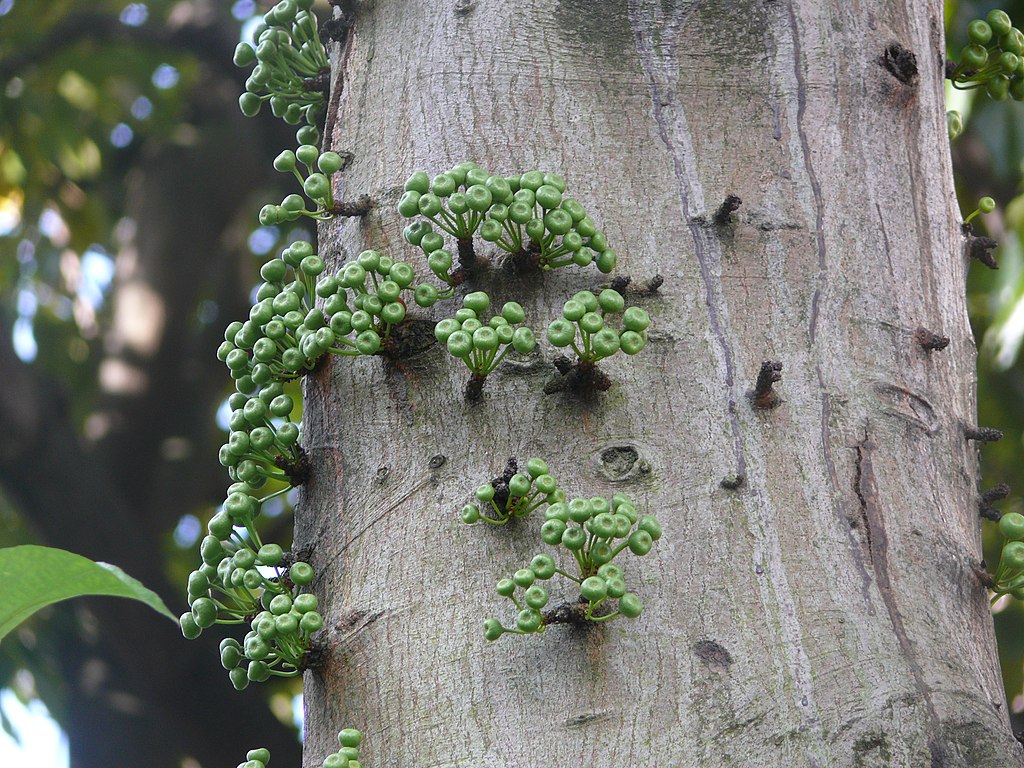 |
Ficus variegata
Summary