| Genus | Ficus |
|---|---|
| Species | langkokensis |
| Common Name | langkokensis |
| Description | Download the RNA-Seq raw fastq sequences Download the RNA-Seq assembled sequences and annotation Related analysis: Detailed information: It is produced in Fujian, Guangdong, Guangxi, Hainan, Sichuan and Yunnan (from the south to the southeast); It is also distributed in Northeast India (Assam), Laos and Vietnam (north of central China).Arbor, 6-15m high, with reddish brown or grayish yellow bark, thin and yellowish brown branchlets, covered with rusty bran like hairs.Banyan fruits are paired or solitary in leaf axils, spherical, 5-12mm in diameter, covered with rusty bran like hairs, with umbilical bulges at the top, basal bracts 3, broad ovate, total stem thinner, 5-15mm long, covered with rusty bran like hairs. Ficus langkokensis can be characterized by its specific morphological traits such as leaf shape, size, and the structure of its fruits, known as syconia. Mountains, beside streams; 100-2000 m. Fujian, Guangdong, Guangxi, Hainan, SW Hunan, S Sichuan, S Yunnan ,NE India, Laos, Vietnam. This species is part of the broader ecological community, playing a crucial role in its habitat. As a keystone species, it supports a wide variety of wildlife, providing both food and shelter. The fruit of Ficus langkokensis serves as a critical food source for numerous bird and mammal species, which also aids in seed dispersal, essential for the propagation of the species across its native landscape. |
| Organism Image | 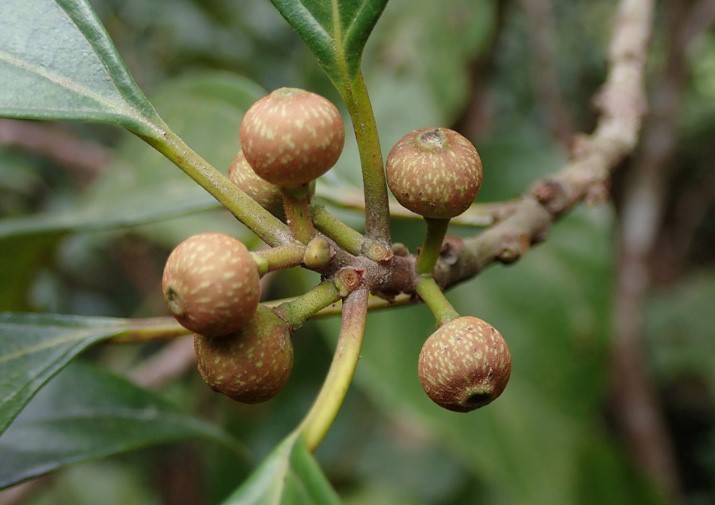 |
Ficus langkokensis
Summary